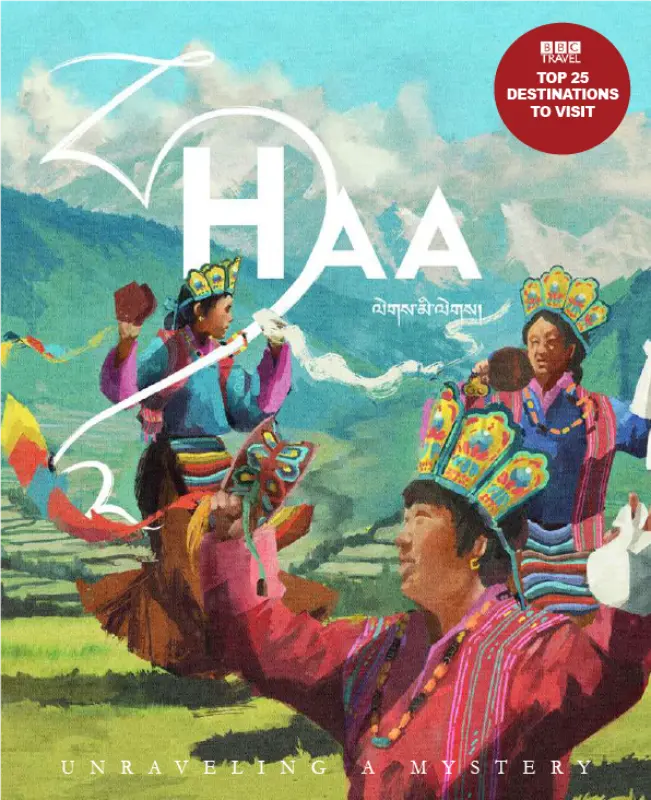
By a photographer who lost his heart in Bhutan in September
It’s September. The air is fresh, and the sky over Bhutan seems to have a depth that I don’t know from Europe. I have been traveling for several days as part of a group of photographers from Amazing Aerial. Our goal: to capture the soul of this country with photos in 15 days. But now that I’m back home, if I close my eyes, I don’t see the editorial images we had planned. I see a quiet valley, hidden behind high mountains. I see Haa.
I am writing this as an entry in my travel diary to preserve the memory of a day that felt less like a photo expedition and more like a step into another, more peaceful time.
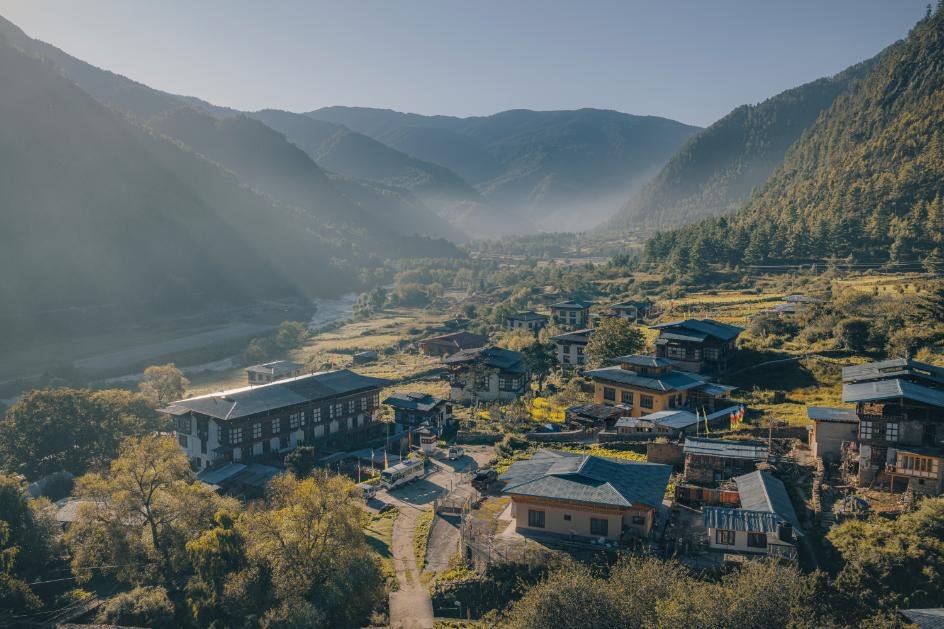
The ride above the clouds
Our day began well before sunrise, and everyone was tired and a little cranky from waking up so early. We started our journey in Thimphu, the capital, and drove through the Paro Valley before the road climbed higher and higher. Curve after curve, the road wound its way through dense forests of blue pines and rhododendrons. Our destination was the Chele La Pass, the natural barrier and gateway to the Haa Valley.
When we reached the highest point at almost 4,000 meters, I was left gasping for breath. But up here, our special privilege came into play: We had received one of the rare permits for drone flights in the Kingdom of Bhutan.
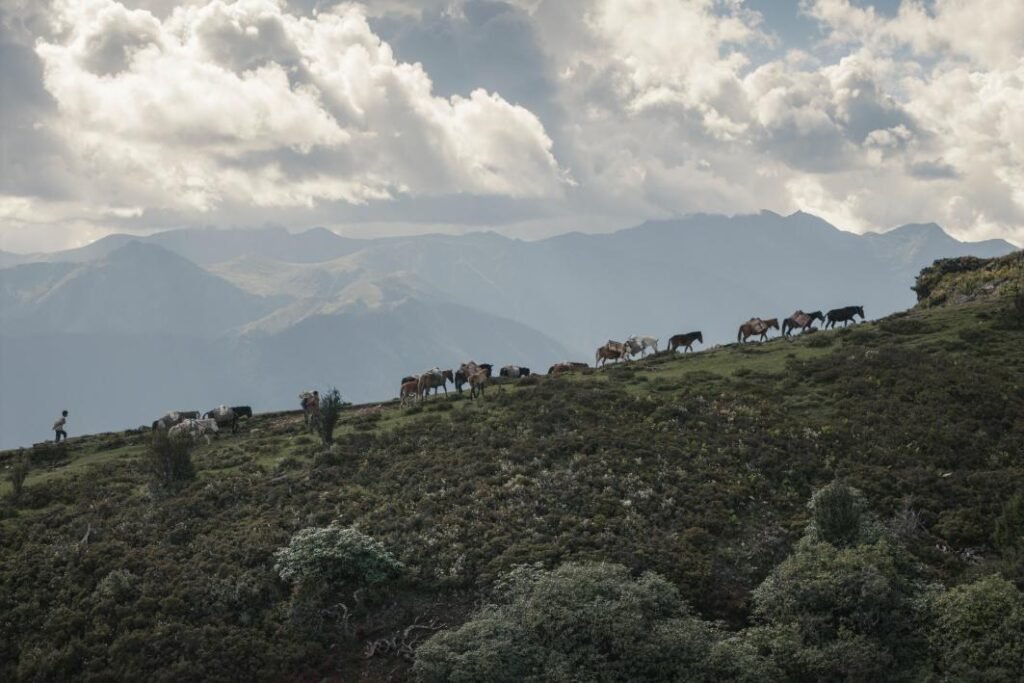
It was windy and cold, probably typical for a September morning at this altitude. While hundreds of prayer flags fluttered wildly in the wind, we launched our drones. The view on the remote-control screen was fascinating, even though the weather god denied us a wish today: The famous snow-covered giants of the Himalayas on the horizon remained hidden behind a thick wall of clouds. But that didn’t ruin the mood. From up there, the world still looked majestic. From above we saw how the road wound like an endless ribbon thru the green mountains. A little further away, on the steep hills, we then discovered a transport of goods with packhorses. The small silhouettes climbed the mountain paths undeterred. This spectacular bird’s-eye view, with the rugged beauty of the cloud-covered mountain region, was a moment that made all the effort worthwhile.
The Dance of the Monks at Haa Dzong
After descending into the valley, the atmosphere changed. Haa welcomed us with a tranquillity that was almost palpable. There was no traffic noise, no hustle and bustle. Compared to the massive fortresses in Punakha or Thimphu, this place felt more intimate, but no less impressive. Our path led us directly to the homestay, but then something unexpected happened: As we drove past Haa Dzong, we caught sight of movement in the courtyard through the open gate. It was clear that we had to stop here immediately to capture this unique spectacle.

We were lucky. We were not mere spectators, but witnesses to real life. A group of monks was just conducting their training. But it was no ordinary training. They moved in a large circle in the courtyard. It was a kind of dance, rhythmic and synchronized. The deep red robes whirled thru the air, providing a wonderful contrast to the white walls of the dzong. They practiced steps that radiated both strength and absolute concentration. There was a fascinating sense of discipline. All you could hear was the rhythmic sound of feet on the stone floor. It was hypnotic to watch. In that moment, I realized that culture in Bhutan is not something to be viewed in a museum – it is lived.
A home away from home
As the sun began to set behind the mountains, the valley was bathed in a soft, blue light—the “blue hour” that we photographers love so much—we set off to our accommodation. We had planned a stay in a homestay in Haa.
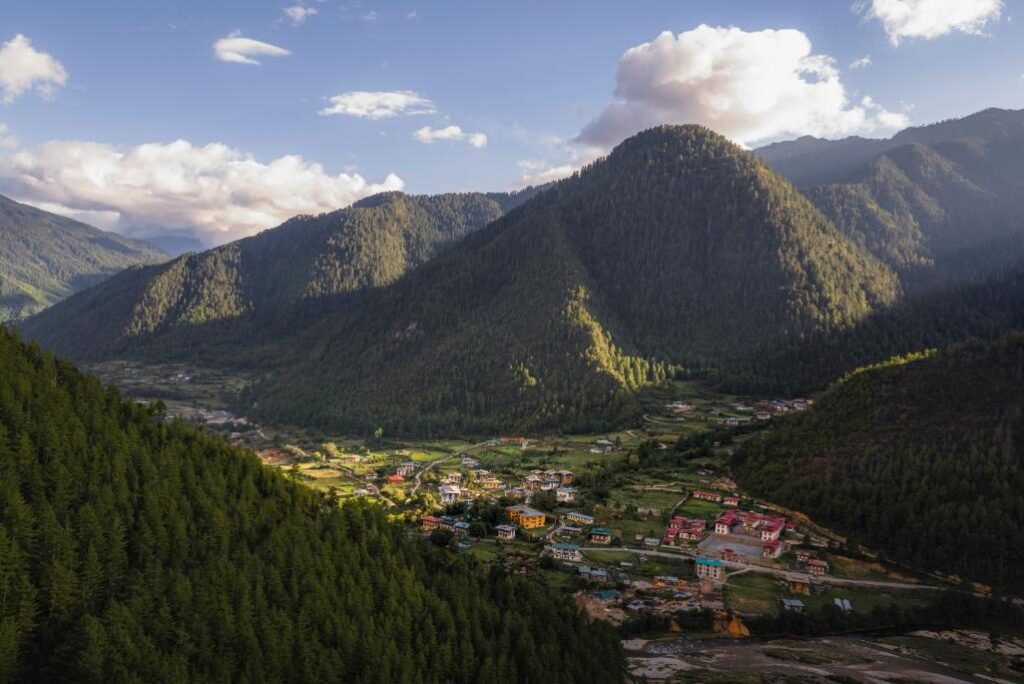
The house was a jewel of traditional Bhutanese architecture and a dream of a motif. The wood was darkened by time and smoke from the stove, and the walls were thick. The window frames were artistically painted; each detail told a story.
But what truly made this house special were not the walls, but the people within them. Our hosts welcomed us not as customers, but as long-missed friends. The warmth of their hospitality was so generous and loving that we immediately felt at home on our trip. We sat in the kitchen, the heart of the house, around the warm stove. It smelled of butter tea and chili. That night, snuggled up in thick blankets in this unique old house, I put my camera aside. Some memories don’t need to be stored on a sensor; you just have to feel them.
Haa may not be the loudest or most famous valley in Bhutan. But for me, it is the place where I felt the soul of the country most clearly.
– Michael Chlebek
@walkovertheworld
About the Author
Hi, I am Michael, a passionate travel and landscape photographer based in Germany. My journey into photography began in 2012, and over the past decade, I have dedicated myself more seriously to capturing the world’s beauty. From remote landscapes to vibrant cityscapes, I am always in search of unique moments that tell a story.
Early on, I embraced aerial photography, flying drones since 2016, when DJI released the first Mavic Pro. This perspective unlocked new creative possibilities, and more than two years ago, I joined the Amazing Aerial Agency which enabled me the possibility to visit Bhutan using my drone.