Among the most ancient and revered religious monuments in Bhutan, Lhakhang Karpo (White Temple) and Lhakhang Nagpo (Black Temple) stand as enduring symbols of the spiritual legacy of the Haa Valley. These twin temples are believed to be among the oldest surviving lhakhangs in the country, with origins tracing back to the 7th century, during the reign of the Tibetan king Songtsen Gampo, a pivotal figure in the spread of Buddhism across the Himalayan region.
According to a prominent legend, King Songtsen Gampo released a pair of pigeons—one white and one black (described in some accounts as rays of light) to determine the sacred sites where temples should be built. The pigeons landed at two separate locations in the Haa Valley, marking the precise spots where Lhakhang Karpo and Lhakhang Nagpo were subsequently constructed under royal command. This divine act cemented the valley’s place as a spiritually blessed landscape.
Another enduring oral tradition recounts that both temples were built by a mysterious group of men who suddenly emerged from behind Meri Phunsum, the sacred mountain overlooking the valley. Their unexpected appearance and swift construction of the temples gave rise to the valley’s name, “Haa,” derived from the word “Hay” (ཧས), meaning “sudden” or “surprise.”
Lhakhang Karpo, the larger of the two temples, holds exceptional importance in the religious life of the valley. It houses the central monastic body of Haa and serves as the main seat of Ap Chundu, the guardian deity of the region. As the spiritual nucleus of the valley, the temple plays a vital role in major religious ceremonies, annual festivals, and community rituals.
Architecturally imposing yet serene, Lhakhang Karpo stands as a symbol of continuity, linking the ancient introduction of Buddhism with the living religious traditions of today. Its status as the central monastic institution underscores its importance not only as a historical monument but as an active place of worship.
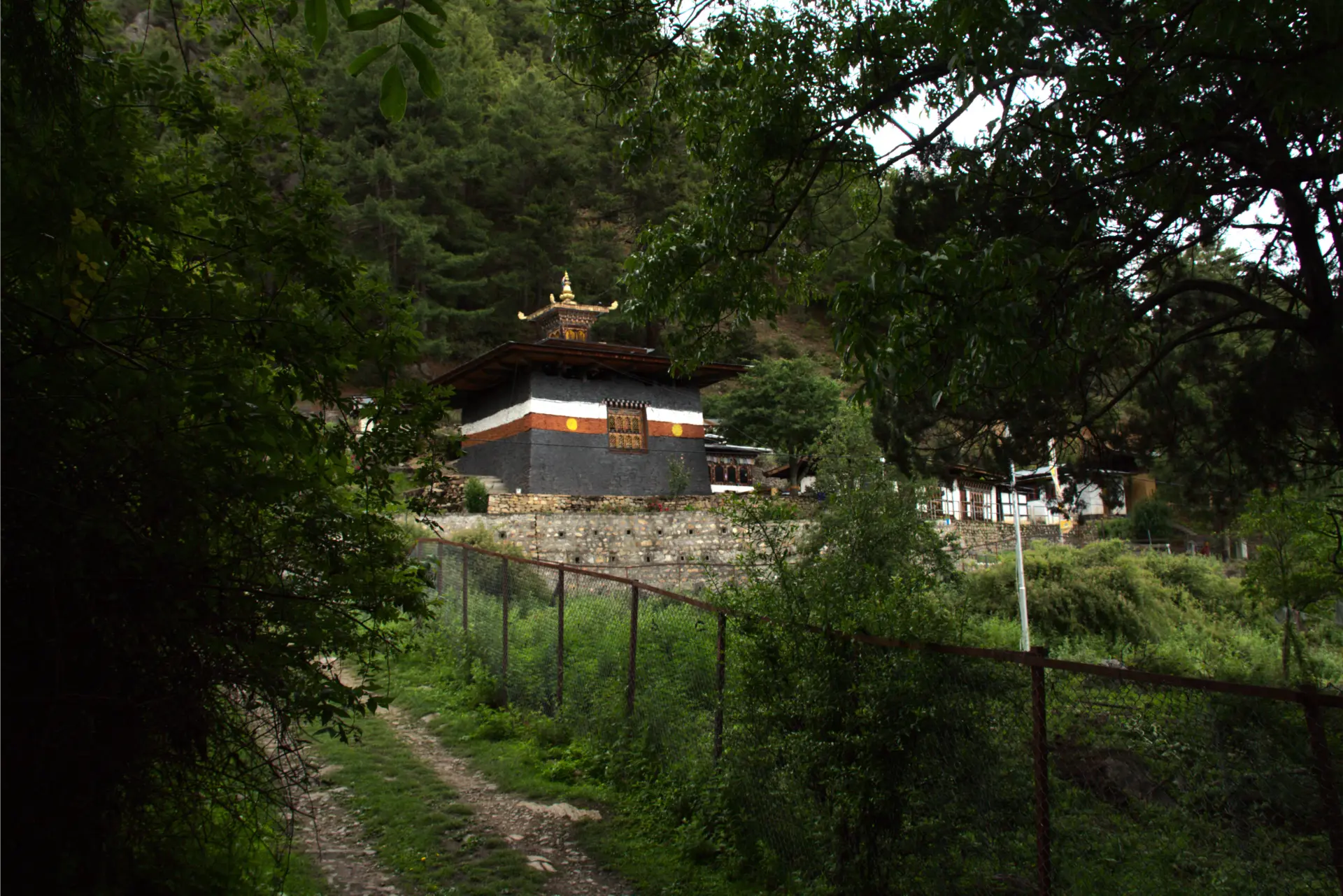
In contrast, Lhakhang Nagpo is smaller in size yet equally profound in spiritual significance. The temple is uniquely built on a lake, with a mysterious opening in its floor that leads directly to the water below—an architectural feature that adds to its sacred aura and symbolic depth.
One of the temple’s most remarkable elements is its main statue, which is said to closely resemble the Jowo statue housed in the Jokhang Temple in Lhasa—one of the most sacred Buddhist images in the Tibetan Buddhist world. This likeness strengthens the historical and spiritual connection between Bhutan and Tibet during the early spread of Buddhism.
Together, Lhakhang Karpo and Lhakhang Nagpo represent more than architectural heritage; they embody the mythic origins, spiritual authority, and cultural identity of the Haa Valley. For pilgrims and visitors alike, these twin temples offer a rare glimpse into Bhutan’s earliest Buddhist history—where legend and faith converge, and where the sacred past continues to shape the spiritual landscape of the present.
Location: Dumcho ( Eusu Gewog)
In between Dumcho bridge and Imtart
Distance: Lhakhang Karpo – 3.3 km/ 6 min from Haa Town
Lhakhang Nagpo- 4.5 km/ 10 min from Haa town
Find location on google map